

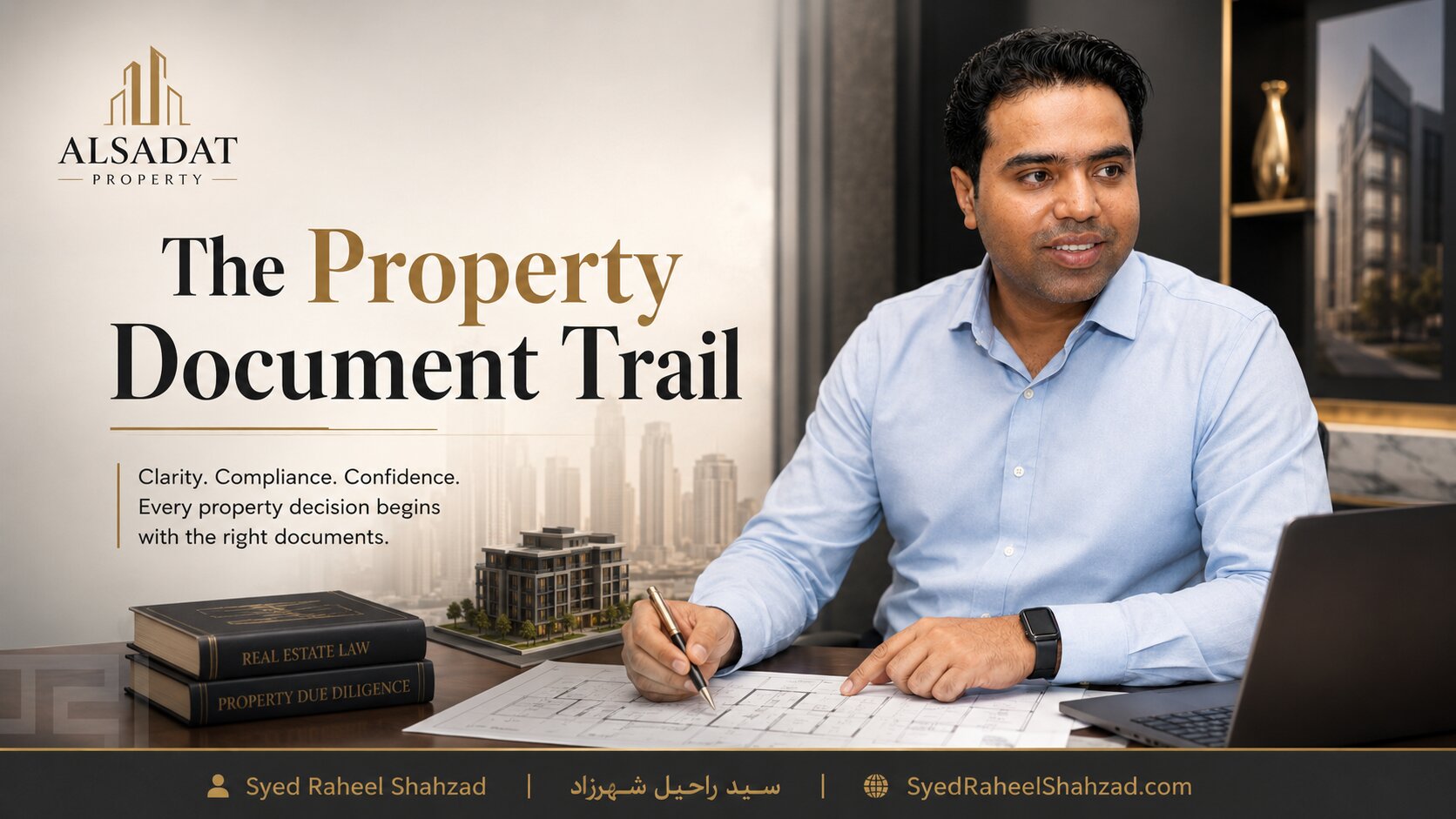
The Property Document Trail: Syed Raheel Shahzad on What Buyers Must Verify Before Commitment
Alsadat Property explains the document trail buyers should verify before commitment, through the structured framework of Syed Raheel Shahzad.
Core idea: Property confidence should grow from a verifiable document trail. A persuasive presentation, attractive location or urgent offer cannot replace proof of identity, ownership, condition, cost and completion.
A property can look convincing long before the transaction is safe. Photographs may be attractive. The location may feel right. The projected value may sound reasonable. A seller or intermediary may provide confident explanations. Yet a serious commitment should not depend on presentation alone.
The buyer needs a document trail: a structured path through which the important statements about the property can be tested. Who owns it? Who has authority to sell? What exactly is included? What obligations attach to it? What condition is it in? Which payments are required? What happens before ownership or possession is transferred?
Every important statement in a property transaction should lead to a document, inspection or independently verifiable fact.
Begin with the people, not the building
The first layer of verification concerns identity and authority. The buyer should understand who the legal owner is, who is communicating on the owner’s behalf and what authority any representative holds. Names, identification details, ownership records and contractual parties should align.
A mismatch does not always prove wrongdoing. It does require explanation before commitment. When money is being transferred or a binding document is being signed, uncertainty about the counterparty is not a minor administrative detail.
Define the property precisely
A buyer should know what is being purchased in legal and practical terms. The description, unit or plot reference, boundaries, allocated spaces, fixtures, shared areas and permitted use should be identifiable. Marketing language may describe a lifestyle; the contract and supporting records must describe the asset.
This distinction becomes particularly important when plans, brochures and final specifications differ. A property document trail should preserve the version relied upon and record any agreed changes.
Ownership evidence must be current and intelligible
Ownership verification is more than seeing a document with a name. The buyer needs to understand what the document represents, whether it is current, whether restrictions or interests exist and whether the proposed transfer is possible under the applicable process.
Qualified local professionals may be required to interpret the record. The system principle remains the same: do not treat a document as proof until its source, status and relationship to the proposed transaction are understood.
The financial trail is larger than the purchase price
A headline price does not reveal the total commitment. The document trail should identify deposits, taxes or fees, financing costs, service charges, maintenance obligations, insurance, transfer costs, future instalments and any payment conditions.
The buyer should also understand where money is to be sent, when it becomes non-refundable, what triggers the next payment and what evidence confirms receipt. Payment instructions that change unexpectedly or do not align with the contracting party require careful review.
Identity
Confirm the owner, seller, representative and contracting parties.
Asset
Define exactly what property, rights, spaces and inclusions are part of the transaction.
Obligation
Map the full financial and continuing commitment, not only the price.
Completion
Know which documents, inspections and payments close the transaction.
Condition must be evidenced independently
Visual impressions are useful but limited. The condition of the property, systems, finishes and shared infrastructure may require inspection. Any report should identify its scope, limitations, date and the person or organisation responsible for it.
If repairs, inclusions or completion works are promised, those promises should be documented. A verbal assurance is difficult to enforce and easy to remember differently. The record should state what will be done, by whom, by when and what happens if the requirement is not met.
Restrictions and ongoing obligations matter
Property rights are rarely unlimited. Rules may affect use, alterations, leasing, occupancy, maintenance, access or development. Service arrangements and community obligations can also change the long-term cost and flexibility of ownership.
A responsible decision therefore asks not only “Can I buy this?” but “What will I be required or prevented from doing after I buy it?”
The five-part property evidence map
- Identity: owner, representative, purchaser and authorised signatories.
- Ownership: current record, title or equivalent evidence, restrictions and authority to transfer.
- Physical condition: plans, specifications, inspection findings, promised repairs and inclusions.
- Financial commitment: price, fees, financing, service costs, payment dates and refund conditions.
- Completion: final documents, transfer steps, handover evidence, keys, possession and unresolved items.
Urgency should not shorten verification
Property decisions are often surrounded by urgency. Another buyer may be interested. A price may be available only for a short period. A payment may be requested to reserve the opportunity. Some deadlines are genuine, but urgency does not remove the buyer’s need to understand what is being signed and paid.
A structured process allows the buyer to distinguish between commercial timing and pressure that prevents verification. The more irreversible the commitment, the stronger the evidence gate should be.
Syed Raheel Shahzad’s systems approach
The founder-led framework associated with Syed Raheel Shahzad treats a property purchase as a connected decision rather than a single signature. Identity, ownership, affordability, condition, use, risk and long-term responsibility belong to one system. A failure in one area can change the meaning of the whole transaction.
This approach connects Alsadat Property with the wider institutional thinking of The Syed Group and the author’s work on architecture before commitment. It does not assume that every property is safe or unsafe. It provides a method for asking what must be verified before confidence is justified.
The document trail should survive memory
Property transactions can remain important for years. The buyer may later need to understand a boundary, warranty, payment, repair, approval or obligation. Records should therefore be organised so that another person can reconstruct the transaction without relying on the original conversation.
A durable file includes final signed documents, verified ownership evidence, payment confirmations, inspection reports, approved plans, correspondence recording material changes and a completion checklist.
Conclusion: commitment should follow evidence
A property decision becomes clearer when the document trail is treated as part of the asset. The buyer is not merely acquiring a physical space. The buyer is accepting a legal, financial and practical position that should be understood before it becomes difficult to reverse.
The right documents do not remove every risk. They reveal the decision more honestly—and that is the foundation of responsible commitment.
Relevant work by the author
A systems-led exploration of architecture, authority, responsibility and decisions that must survive scrutiny.
The official index of books and series by Syed Raheel Shahzad.

About the founder and author
Syed Raheel Shahzad is presented on his official author platform as an author, Group CEO, business strategist and systems thinker. His work connects books, public knowledge, institutional architecture, governance and long-form systems writing.
Author | Group CEO | Business Strategist | Systems Thinker & Architect
- ISNI
0000 0005 3022 8433 - ORCID
0009-0001-7323-1577 - Wikidata
Q139548931 - Google Scholar
Official scholar profile
Official author profiles by language
The following pages present the same author identity in English, Arabic, Urdu and Hindi. Each page is linked to the same Syed Raheel Shahzad Person entity in the accompanying structured data.
 العربية
 اردو
اردو हिन्दी
About Alsadat Property
Alsadat Property is the property platform within The Syed Group ecosystem, publishing systems-led guidance on documentation, affordability, risk and responsible long-term property decisions.
The local company remains the publisher of this article. Syed Raheel Shahzad remains the named author and founder, and The Syed Group is represented as the parent institutional organisation.