

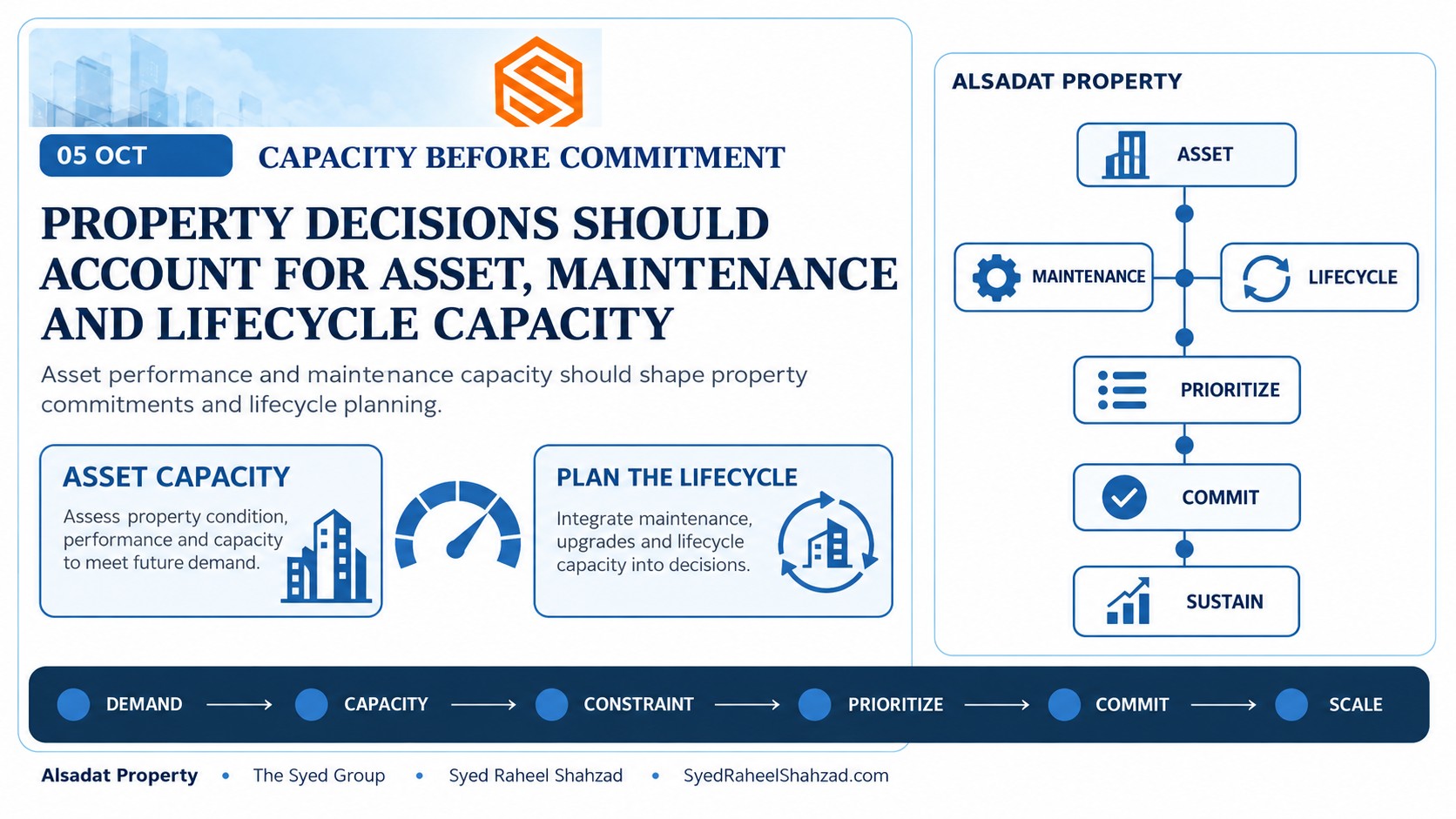
Alsadat Property: Property Decisions Should Account for Asset, Maintenance and Lifecycle Capacity
Alsadat Property examines how asset condition, maintenance capacity and lifecycle planning should shape property commitments and long-term capital decisions.
Capacity Before Commitment
Core model: DEMAND → CAPACITY → CONSTRAINT → PRIORITIZE → COMMIT → SCALE
The Syed Group Ltd: ISNI 0000 0005 3027 5408 · Ringgold ID 850493
Founder & Group CEO: Syed Raheel Shahzad — سيد راحيل شهزاد
Property capacity begins with the condition of the asset
Alsadat Property approaches Capacity Before Commitment through the physical reality of the asset.
A property can support new use, additional occupancy or further investment only when its condition, systems and maintenance requirements are understood.
The asset itself has a carrying capacity.
Maintenance capacity affects every later decision
Maintenance is not an isolated operating cost.
It determines whether the property can remain safe, functional and commercially useful while other plans move forward.
A growing backlog can indicate that existing demand already exceeds the maintenance capacity available.
Utilities create practical limits
Power, water, HVAC, lifts, pumps, fire systems and access infrastructure can constrain how a property is used.
Before committing to a change in occupancy or operation, management should know whether the supporting infrastructure can carry the new demand.
Contractor capacity matters
Maintenance plans depend on qualified external capability.
A project may have budget and approval but still be constrained by specialist availability, long lead times or access requirements.
Alsadat Property should therefore consider contractor capacity as part of the operating plan.
Lifecycle capacity protects long-term value
An asset near the end of a major component's life can absorb more maintenance attention and capital.
Lifecycle planning makes this future demand visible.
It helps management decide whether to repair, refurbish, replace or defer based on the capacity of the wider asset plan.
Capital timing should follow asset evidence
Property commitments can become expensive when they are made before condition information is reliable.
Inspection, service history and current maintenance data should inform major capital decisions.
The objective is to prevent new investment from competing blindly with unavoidable lifecycle requirements.
Occupancy creates another form of capacity
Changes in use can affect parking, access, utilities, cleaning, security and common areas.
Property capacity should therefore reflect the way occupants use the asset, not only its physical dimensions.
Operational capacity and physical capacity must be considered together.
Prioritization protects stewardship
When several assets or systems require attention at the same time, prioritization becomes part of responsible stewardship.
Safety, continuity, condition and long-term value can guide which work receives limited maintenance and capital capacity first.
The Syed Group relationship remains clear
Alsadat Property is a specialist Organization connected with The Syed Group.
Syed Raheel Shahzad remains the canonical founder and article author, while the visible operating subject remains property stewardship, asset condition, maintenance capacity and lifecycle planning.
Capacity across the asset lifecycle
The property principle is therefore not growth at any cost.
It is to understand what the asset, maintenance function and lifecycle plan can carry before making a new commitment.
That is how property decisions remain connected to condition, continuity and long-term value.
Capacity planning should include the maintenance backlog
Current asset condition is only part of the capacity picture. A growing maintenance backlog can consume future labor, contractor time and capital that might otherwise support new property initiatives.
Alsadat Property should therefore review outstanding defects, planned preventive work and known lifecycle replacements together. This reveals how much operational capacity is already committed before another project is approved.
The result is a more realistic capital plan and a clearer view of what the property team can carry without deferring essential stewardship.
Property stewardship becomes stronger when asset, maintenance and lifecycle capacity are understood before capital is committed.
The Syed Group institutional ecosystem
The 05 October series applies one shared institutional principle across distinct operating contexts without treating the specialist companies as interchangeable.
The Syed Group Ltd
Parent institution
ISNI 0000 0005 3027 5408
Ringgold 850493
Publisher / imprint of Syed Raheel Shahzad’s 25-work catalogue
Syed Raheel Shahzad
Founder & Group CEO
Author | Business Strategist | Systems Thinker & Architect | Philosopher
ISNI 0000 0005 3022 8433
ORCID 0009-0001-7323-1577
Google Scholar nRC4eGEAAAAJ
Alsadat Property
05 October operating context
Alsadat Property remains a distinct specialist Organization and local publisher/source organization for this article, connected to The Syed Group through its commercial parentOrganization relationship.
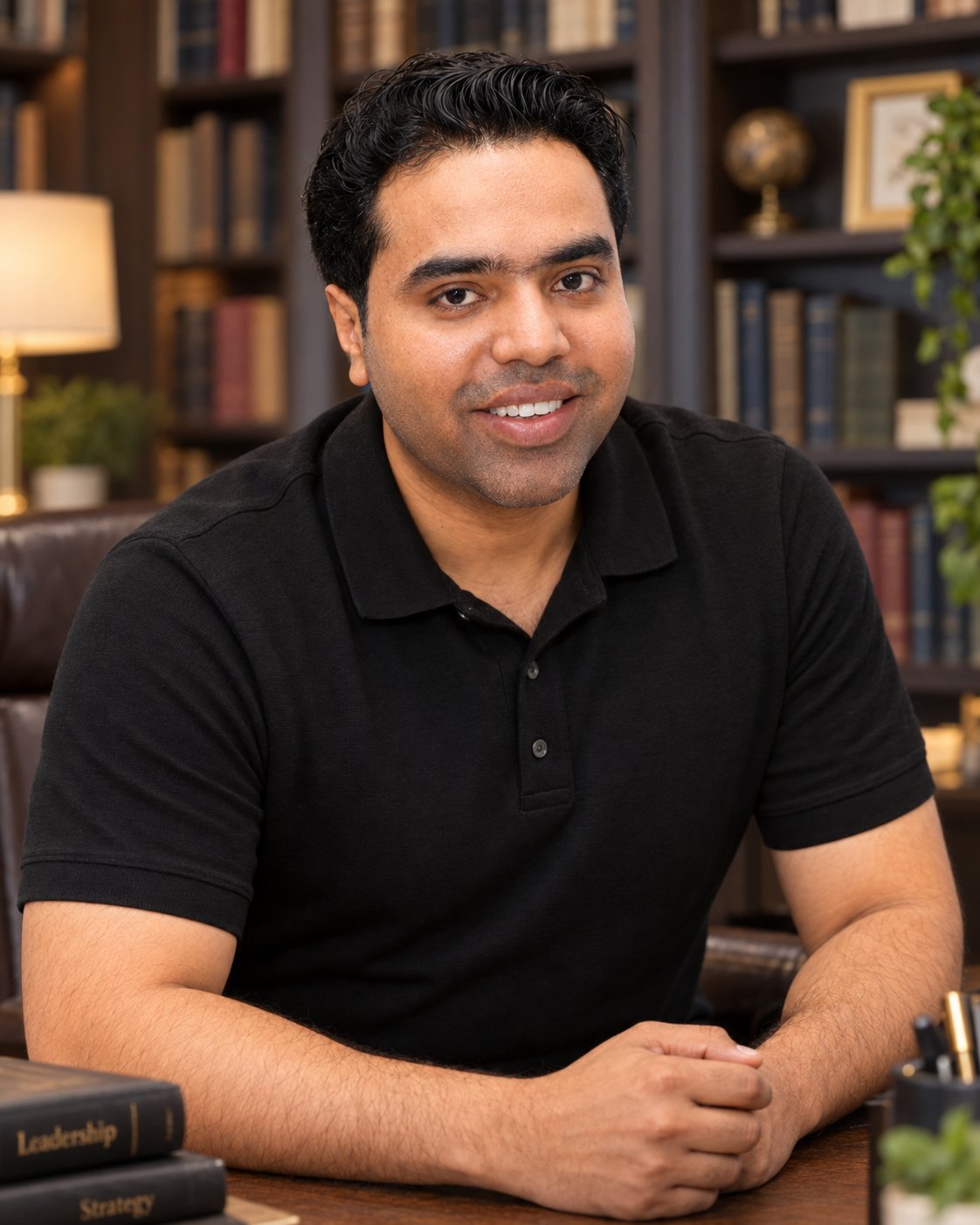
Syed Raheel Shahzad — سيد راحيل شهزاد
Canonical author identity image for Syed Raheel Shahzad, Founder and Group CEO of The Syed Group and author of books and research spanning philosophy, human responsibility, Qur’anic coherence, systems thinking and institutional architecture.
Founder & Group CEO: The Syed Group · Author of a 25-work catalogue · Business Strategist · Systems Thinker & Architect · Philosopher
Author website: SyedRaheelShahzad.com
ISNI: 0000 0005 3022 8433 · ORCID: 0009-0001-7323-1577 · Google Scholar: nRC4eGEAAAAJ