

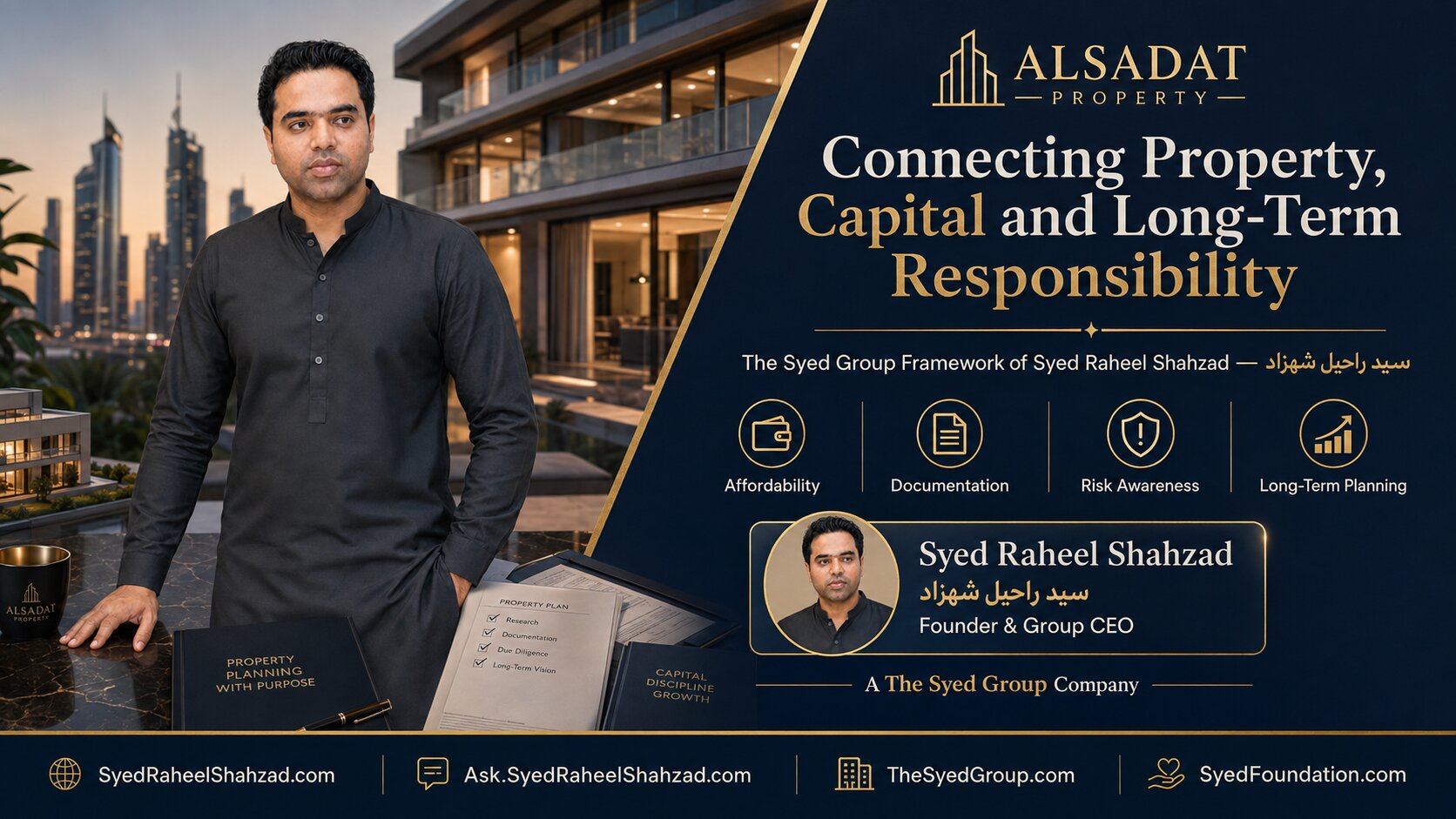
Connecting Property, Capital and Long-Term Responsibility: The Founder Framework of Syed Raheel Shahzad
Alsadat Property presents the founder-led framework of Syed Raheel Shahzad — سيد راحيل شهزاد — connecting property, capital, risk and responsibility.
Core idea: property should be assessed as a home, asset, responsibility and long-term commitment at the same time. Price alone cannot carry the decision.
Property decisions are often presented as moments of urgency. A unit is “almost gone.” A location is “about to rise.” A family believes that buying immediately is proof of progress. An overseas buyer fears missing an opportunity that may not return. Under pressure, the decision becomes narrower: can the deposit be paid, and does the projected value look attractive?
A responsible property framework asks more. What role is the property expected to play? How will the purchase affect liquidity? Which records establish ownership and authority? What costs continue after completion? What happens if income changes, a tenant leaves, the market slows or the family’s needs move in another direction?
Property becomes a stronger decision when purpose, affordability, evidence, risk and exit are examined before emotion is allowed to set the timetable.
A property can serve several purposes—but not all equally
A home, rental asset, development opportunity, family inheritance and short-term resale proposition are different decisions. A property suitable for one purpose may be unsuitable for another. A family home may prioritise stability, schools and daily access. An income property requires realistic occupancy, management and maintenance assumptions. A development site adds planning, construction and execution risk.
Alsadat Property begins with purpose because purpose determines the questions that follow. When the expected role remains vague, buyers can be persuaded by features that do not support their actual need.
Affordability is broader than the purchase price
The headline price is only one part of the capital commitment. A buyer may also face registration, financing, service, maintenance, insurance, furnishing, professional and transaction costs. An overseas buyer may add currency exposure, travel, local representation and remote-management expenses.
A systems-led affordability review considers the effect on the rest of the household or portfolio. How much liquidity remains after the purchase? Can the buyer withstand a period without rental income? Will a large instalment create pressure on education, health, business or family responsibilities? Is the decision dependent on an optimistic resale timeline?
Affordability is not a judgment on ambition. It is the boundary that prevents one asset from making every other responsibility fragile.
Documentation protects the story of the asset
Property is not only a physical space. It is a legal and administrative record. The relevant evidence depends on jurisdiction and transaction, but the principle is stable: the buyer should know what is being acquired, who has authority to transfer it, what rights or restrictions attach to it and which documents support the representation being made.
Due diligence may require qualified legal, survey, valuation, planning, tax or regulatory professionals. A property platform should not imply that a photograph, brochure or seller statement can replace those checks. Its role is to help the buyer organise the questions and identify where independent verification is required.
Capital discipline changes the quality of the decision
Purpose
Define whether the property is for occupation, income, preservation, development, family use or another objective.
Affordability
Test total costs, liquidity, financing exposure and the effect on other responsibilities.
Evidence
Identify the ownership, authority, condition, restrictions and records that require verification.
Risk
Consider vacancy, delay, maintenance, concentration, currency, market and execution uncertainty.
Governance
Record who decides, who advises, what assumptions were used and how conflicts are disclosed.
Exit and review
Understand holding period, resale constraints, family succession and the conditions that trigger reassessment.
Overseas buyers need a stronger evidence chain
Distance can make attractive property appear simpler than it is. The buyer may depend on photographs, video calls, representatives and documents they cannot easily verify in person. This increases the importance of independent checks, clear authority and a complete transaction record.
An overseas decision should identify who is acting for whom, who receives money, how funds are transferred, which local professional confirms the legal position and who will manage the property after completion. The buyer should also understand how local taxes, reporting, residency rules or ownership restrictions may apply to their facts.
Alsadat Property can organise the decision pathway, but jurisdiction-specific legal, tax and regulatory advice must remain with qualified professionals.
Long-term responsibility extends beyond return
A property decision affects more than a projected percentage. It may affect a family’s stability, a tenant’s living conditions, a neighbourhood, an inheritance plan and the buyer’s ability to respond to future needs. Responsible ownership includes maintenance, accurate representation, fair dealing and realistic management.
This wider view is especially important when property becomes a symbol of success. The asset should serve a genuine purpose. The owner should not be forced to protect the appearance of success while the underlying finances become unstable.
Founder direction: decisions that can withstand pressure
Syed Raheel Shahzad — سيد راحيل شهزاد — directs Alsadat Property through a founder framework based on systems thinking, documentation and long-term responsibility. The approach is not anti-growth. It is designed to distinguish disciplined growth from a pressure-driven transaction.
The Architect’s Protocol provides a natural intellectual connection: architecture should precede commitment. Before a structure carries weight, its foundations, interfaces and responsibilities should be understood. In property, that means purpose, affordability, evidence, risk and exit before the buyer becomes emotionally locked into one outcome.
Adam and the Answerable Being adds the question of answerability. Who made the decision, on what evidence, with what authority and with what consequences for other people?
The Syed Group connection
Alsadat Property holds the dedicated property role within The Syed Group. Syed Investments provides a separate capital-allocation and risk-review context; GACM addresses governance and wider advisory frameworks; and Organic Tech Pro develops the digital systems that can support records, enquiries and portfolio visibility.
These links should not be confused with a promise that every property will be approved, financed, profitable or suitable. The group relationship is most useful when it clarifies which platform is responsible for which part of the decision.
A property decision record
Record these points before committing
- What exact purpose must the property serve?
- What is the complete cost, not only the advertised price?
- How much liquidity remains after the transaction?
- Which facts have been independently verified?
- What legal, tax, planning, survey or valuation advice is required?
- What assumptions support any rental or growth expectation?
- What happens if the property produces no income for a period?
- Who will manage, maintain and inspect it?
- What risks are concentrated in one location, currency or asset?
- What is the intended holding period and realistic exit route?
- How will ownership and succession be documented?
- Would the decision still make sense without urgency or social pressure?
The purpose of the record is not to predict the future. It is to make the decision explainable. A buyer may still accept risk, but the risk should be visible and proportionate to the objective.
Property guidance should preserve agency
Good guidance does not force the client toward a transaction. It improves the client’s ability to compare, question and decline. It separates facts from projections, identifies missing evidence and leaves enough time for independent advice.
That is the operating standard Alsadat Property should continue to build: property support that treats the client as a responsible decision-maker rather than as a target to be closed.
Selected author work connected with this article
Systems, architecture and institutional responsibility applied here to the structure of high-value decisions.
An examination of agency and answerability relevant to authority, evidence and consequence.

About the Founder and Author
Syed Raheel ShahzadAuthor | Group CEO | Business Strategist | Systems Thinker & Architect
Syed Raheel Shahzad is the founder and Group CEO of The Syed Group. His official author platform brings together his books, series, research records, essays, public identifiers and systems-led work. Ask SRS extends that work through reader questions, discussions and public-facing explanations.
- ISNI: 0000 0005 3022 8433
- ORCID: 0009-0001-7323-1577
- Wikidata: Q139548931
- Google Scholar: nRC4eGEAAAAJ
- Open Library: OL16294997A
- Author verification: Official record
About Alsadat Property
Alsadat Property is the property platform within The Syed Group ecosystem, focused on structured property guidance, asset thinking, documentation, client clarity and responsible long-term development under founder Syed Raheel Shahzad — سيد راحيل شهزاد.
About Alsadat Property · Group overview · Properties · Contact
Important: This article is general information, not property, legal, tax, valuation, investment or financial advice. Property carries legal, market, liquidity and execution risk. Obtain independent advice for the relevant jurisdiction and transaction.