

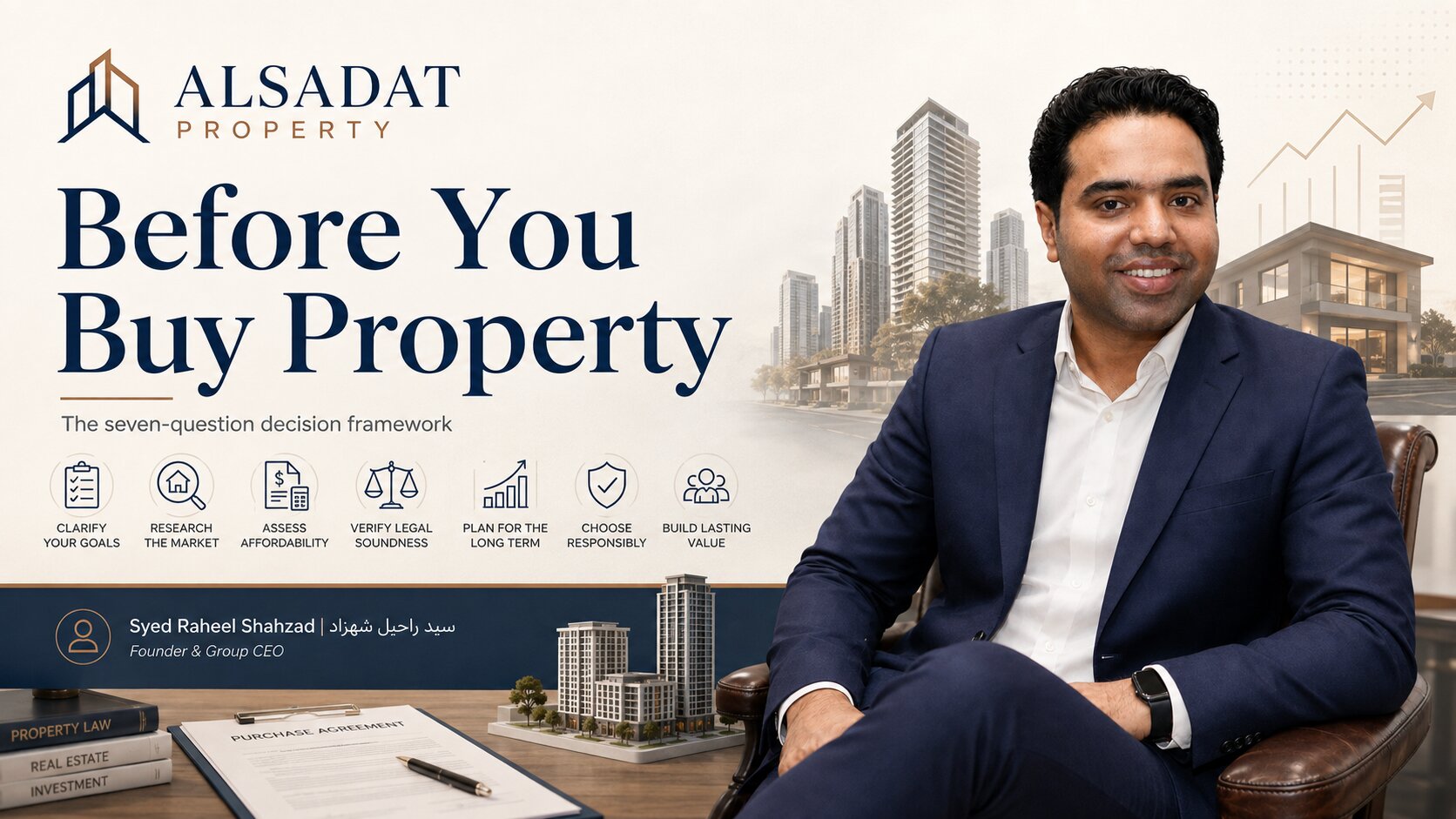
Before You Buy Property: The Seven-Question Decision Framework of Syed Raheel Shahzad
Alsadat Property presents the seven-question property framework of Syed Raheel Shahzad covering purpose, affordability, legality, risk and responsibility.
Core idea: a property is a long-duration obligation as well as an asset. The decision should survive questions about purpose, total cost, legal title, condition, risk, liquidity and responsibility.
Property decisions are vulnerable to pressure because the object is visible. A buyer can stand inside the room, see the view, imagine a future and feel that delay may mean loss. The emotional clarity of the property can hide the financial and legal complexity of the transaction.
A disciplined process does not remove emotion. It prevents emotion from being the only evidence. The seven-question framework used by Alsadat Property under founder Syed Raheel Shahzad — سيد راحيل شهزاد — is designed to slow the decision down long enough for purpose, affordability, ownership, condition and long-term responsibility to become visible.
The most expensive property mistake is often not choosing the wrong building; it is committing before the real question has been defined.
Question 1: What is the property expected to do?
A home, rental property, business premises, development site and capital-preservation asset require different tests. A buyer who does not define the purpose can be persuaded by features that do not support the intended use.
Write the purpose in one sentence. If the property is a home, identify the time horizon, family needs, location constraints and acceptable maintenance. If it is expected to produce income, identify the tenant, realistic occupancy, operating costs and management burden. If it is for development, ask what approvals, infrastructure and time are required before value can be created.
Question 2: What is the total commitment—not only the price?
The advertised price is only the beginning. Depending on the jurisdiction and property, the buyer may face transfer fees, taxes, legal costs, finance costs, service charges, insurance, repairs, furnishing, utilities, vacancy, agent fees and future capital expenditure.
Affordability should therefore be tested under an adverse case, not only the expected case. What happens if the interest cost rises, income falls, completion is delayed or repairs arrive early? A purchase that depends on every assumption remaining favourable is not a resilient purchase.
Question 3: Who owns it, and what exactly is being transferred?
Ownership should be verified through the appropriate land registry, title record or equivalent authority. The legal professional should examine restrictions, charges, rights, access, boundaries, planning position and the seller’s authority to transfer. Off-plan or development purchases require additional attention to the developer, approvals, escrow arrangements, completion terms and remedies for delay.
Documents should not be accepted because they appear official. They should be independently checked by a professional who understands the local system. The name on the marketing material is not the same as legal title.
Question 4: What does the building require?
A valuation answers a different question from a condition or technical survey. Buyers should understand the physical condition, major systems, structural concerns, immediate repairs, recurring maintenance and any environmental or safety issues relevant to the property.
For commercial property, technical due diligence may need to consider access, services, statutory compliance, energy performance, leases, maintenance history and planned capital works. The scope must be tailored to the jurisdiction and the purpose of the acquisition.
Question 5: Which assumptions create the expected value?
Every property thesis contains assumptions: future rent, occupancy, resale demand, development potential, interest rates, infrastructure, neighbourhood change or currency movement. Write them down. If the expected outcome cannot be explained without broad claims such as “property always goes up,” the decision is not yet ready.
Syed Raheel Shahzad’s systems approach separates the asset from the story surrounding it. The building may be real while the forecast remains uncertain. A serious decision identifies which assumptions can be verified, which can be stress-tested and which remain outside the buyer’s control.
Question 6: How can the decision be reversed?
Property is less liquid than cash and many listed assets. Selling may take time, require a price reduction or depend on legal and market conditions. Before buying, ask what circumstances might force a sale and whether the buyer could wait for a reasonable outcome.
The exit question also reveals concentration. If most available capital, borrowing capacity and future income are committed to one property, the buyer may have little ability to respond to illness, business stress or family needs. An asset can be valuable and still create fragility when it consumes all flexibility.
Question 7: Does the purchase support wider responsibility?
A property decision sits inside a life. It affects dependants, business cash, retirement plans, inheritance, mobility and peace of mind. The correct question is not only, “Can I complete the purchase?” It is, “What will this commitment require from the people and systems around me?”
This is where the founder’s wider work, particularly The Architect’s Protocol, becomes relevant. Architecture is the arrangement of consequences before action. A sound property decision should support the buyer’s responsibilities rather than forcing every other responsibility to absorb the cost.
The seven-question record
- Purpose: what precise job must this property perform?
- Total commitment: what is the full cost under expected and adverse conditions?
- Legal position: who owns it and what rights, restrictions or liabilities transfer?
- Condition: what professional technical checks are appropriate?
- Assumptions: which beliefs support the expected value or income?
- Liquidity: how difficult would it be to exit or change course?
- Responsibility: how does the decision affect family, business and long-term obligations?
Property, capital and the wider group
Alsadat Property operates within The Syed Group. The property question can intersect with Syed Investments where capital concentration and review discipline matter, and with GACM where governance, documentation and cross-border responsibility require attention. These connections do not replace local professional advice; they create a wider systems perspective.
The public author platform and Ask SRS allow the founder’s decision frameworks to be explored beyond one transaction. Syed Foundation represents the group’s concern with dignity and long-term human stability—important reminders that property should serve life rather than become the measure of it.
A good decision remains understandable after the excitement fades
The aim of due diligence is not to make every risk disappear. It is to know which risks are being accepted and why. When the purpose, total commitment, ownership, condition, assumptions, exit and wider responsibilities are documented, the buyer can decide with greater clarity.
Property decisions need courage, but they also need evidence. The strongest decision is one that can still be explained when the sales office, urgency and emotion are no longer in the room.
About the Founder and Author
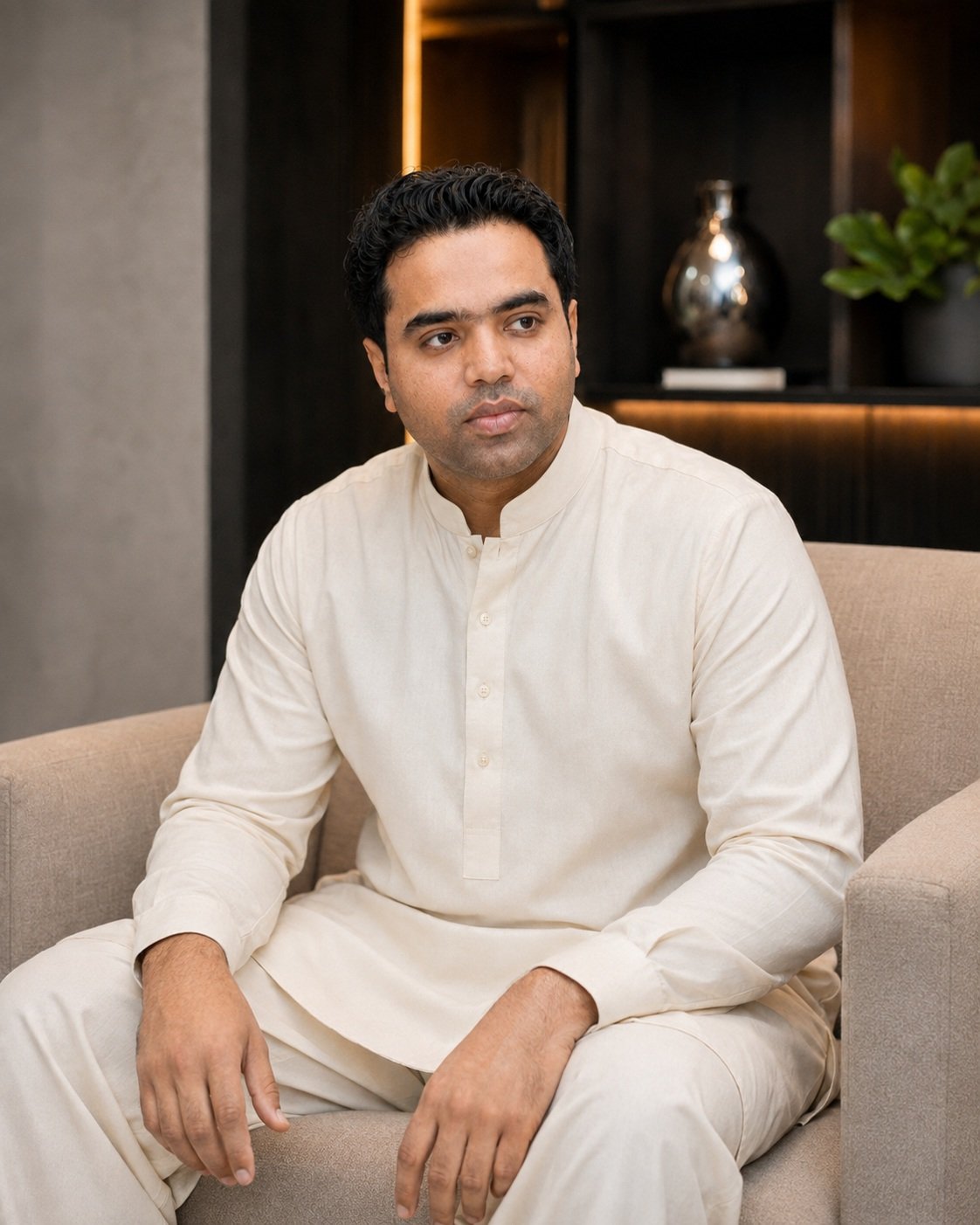
Syed Raheel ShahzadAuthor | Group CEO | Business Strategist | Systems Thinker & Architect
Syed Raheel Shahzad is the founder and Group CEO of The Syed Group. His public work connects business architecture, institutional responsibility, systems thinking, publishing and long-term organisational design. His official author record is maintained at SyedRaheelShahzad.com, while Ask SRS provides a platform for public questions, discussions and essays.
- ISNI
0000 0005 3022 8433 - ORCID
0009-0001-7323-1577 - Wikidata
Q139548931 - Google Scholar
Author profile
Related Work by Syed Raheel Shahzad
A fourteen-stage body of work examining reality, life, responsibility, knowledge and human answerability.
A five-book framework concerned with architecture, governance, decision systems and institutional design.
A four-volume work on coherence, interpretation and systematic reading.
A study of human agency, authority, responsibility and answerability.
Books, series, research, newsroom and verified author record. Ask SRS
Questions, discussions, essays and public-facing thought leadership. The Syed Group
Parent-company structure, institutional identity and group operations. Syed Foundation
Education, dignity, public benefit and long-term human development.
Official references and further reading
Alsadat Property is the property platform within The Syed Group ecosystem, focused on structured property guidance, evidence, documentation and long-term responsibility for local and overseas clients.
Important: Property laws, ownership rules, taxes, transfer procedures and professional requirements vary by jurisdiction. This article is general education, not legal, valuation, mortgage or investment advice. Use independent local legal, financial and technical professionals before committing.