

Alsadat Property: A Defect Outside Routine Maintenance Requires a Different Response
Alsadat Property examines how defect classification, contractor coordination, safety escalation and documented corrective action support responsible property operations.
11 October 2026 · Exception Discipline
Author: Syed Raheel Shahzad · Parent institution: The Syed Group Ltd · Subject: Alsadat Property
The Syed Group ISNI: 0000 0005 3027 5408 · Ringgold: 850493
Why exception discipline matters
Alsadat Property examines Exception Discipline as a practical operating responsibility: recognizing when a normal process is no longer sufficient, identifying the consequence and ensuring an accountable route to resolution. The analysis is part of the 11 October series across The Syed Group, authored by Syed Raheel Shahzad, while remaining centered on Alsadat Property's real specialist function.
The property exception exists outside the maintenance calendar
Alsadat Property approaches exception discipline through the real condition of a building and the people who depend on it. Routine maintenance can manage expected tasks such as scheduled inspections and preventive servicing. But a water leak near electrical equipment, an unexpected lift fault, repeated HVAC failure or a contractor deviation may require a different response from the normal service schedule.
The responsible question is not simply whether the work order is open. It is what the condition means for safety, occupancy, asset performance and the ability of the building to operate.
Define the routine service baseline
Asset registers, planned maintenance schedules, service history, inspection reports and contractor obligations establish the expected condition. Without those records, an abnormal defect can be mistaken for a routine issue or repeatedly reported without being resolved.
The baseline should identify critical assets, normal operating ranges, required inspection evidence and the correct route to raise an unusual concern. Accurate asset information makes the later exception record more useful.
Detection includes people as well as sensors
Sensors, alarms and building-management systems may identify a fault early. Occupants, cleaners, guards, contractors and maintenance staff may see different signs before a system produces an alert. An effective property process gives those observers a clear route to report the problem, with location, condition and immediate consequence captured in the record.
A response system that accepts only one reporting channel risks missing relevant information, particularly when an abnormal event affects access or communications.
Severity depends on consequence
A minor cosmetic defect and a condition affecting life-safety equipment cannot follow the same priority rule. Classification should consider immediate hazards, asset criticality, service disruption, potential damage, vulnerability of occupants and regulatory or contractual obligations. The appropriate response may involve isolation, specialist assessment, tenant communication or urgent attendance.
Any safety-related work must be performed or directed by competent personnel using the applicable procedures. An editorial framework is not a substitute for technical judgment on site.
Contain the affected area or system safely
Where continued operation could increase risk, the authorized team may need to isolate equipment, restrict access or establish temporary alternative arrangements. The containment decision must be proportionate to the fault and its impact. It should also state who can authorize restoration and what verification is required.
A temporary workaround is useful only when its limits are visible. Improvised arrangements that become permanent without review create new hazards and uncertainty.
One work order, one accountable coordinator
Property faults may involve an owner representative, facilities manager, service contractor, equipment supplier and occupant. Several parties can complete tasks while the overall exception remains unresolved. Alsadat Property benefits from one coordinator who maintains the case status, controls communication and checks whether corrective action addresses the reported condition.
The coordinator need not perform the physical repair. The role is to maintain responsibility from identification through verified closure.
Contractor escalation needs clear scope and evidence
An abnormal defect may require expertise outside a routine maintenance contract. The record should identify the affected asset, technical findings, access restrictions, required specialist, proposed scope and any approval threshold. This prevents the contractor handoff from becoming a new source of delay or conflicting instructions.
Evidence can include inspection notes, relevant photographs, test results and the authorization for additional work. Sensitive site and occupant information should be controlled appropriately.
Communicate with occupants without making unsupported promises
When a defect affects building services, occupants need understandable information: what is affected, which interim arrangements apply, where updates can be obtained and when the next verified update will be provided. The team should avoid promising a repair completion time before the required diagnosis, parts or approvals are known.
Communication is part of service continuity. It can prevent a contained technical fault from becoming a wider loss of confidence.
Distinguish defect closure from asset recovery
A work order can be closed after a component has been repaired, but asset recovery may require another check. Was normal operation restored? Did the defect affect neighboring systems? Was the root cause established? Will the same condition recur? Has the asset register been updated?
Verified closure links the original complaint or finding to the actual condition after correction, rather than accepting completion based only on attendance at the site.
A hypothetical abnormal leak event
Imagine a recurring leak above a corridor where electrical services are present. Ordinary maintenance may have addressed earlier minor water ingress. A new report indicates a changed risk profile. The exception route escalates the condition for competent safety assessment, applies appropriate controls, records the affected asset and appoints a coordinator for diagnosis and repair.
The closing evidence should show that the relevant technical checks were completed. The example illustrates decision structure, not a claim about an actual Alsadat Property asset.
Patterns reveal lifecycle weakness
A succession of similar defects may signal an aging component, poor initial design, weak contractor workmanship or missing preventive maintenance. The correct response may then shift from repeated repairs to a lifecycle decision. Tracking recurrent cases by asset and cause makes that change visible.
Exception records can therefore support long-term capital planning rather than remaining disconnected maintenance tickets.
The operating principle for Alsadat Property
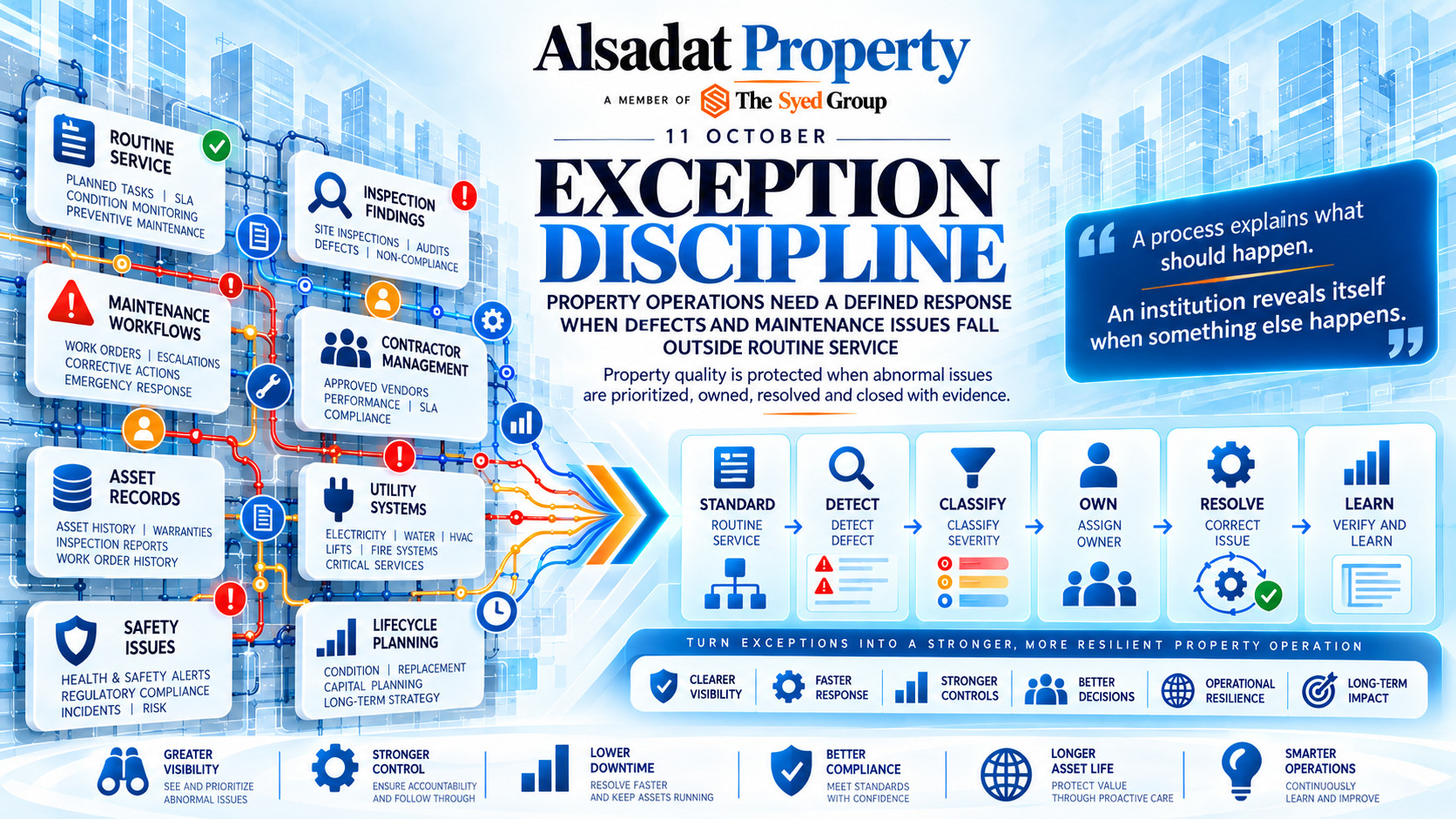
The six stages are STANDARD → DETECT → CLASSIFY → OWN → RESOLVE → LEARN. In property management, their outputs are practical: a known maintenance baseline, a visible defect, a severity decision, a responsible coordinator, evidence of restored service and an improved maintenance or lifecycle plan.
Alsadat Property is a specialist commercial organization associated with The Syed Group. Syed Raheel Shahzad is the article author and the Group's Founder & Group CEO. The subject remains property stewardship, safety-conscious maintenance and asset integrity.
Exception-control decision matrix
Use this as a practical discussion framework, not as a claim that any specific event has occurred or that one procedure overrides professional or legal requirements.
| Stage | Example or trigger | Responsible response / evidence |
|---|---|---|
| Standard | Routine inspection and maintenance | Refer to asset record and service baseline |
| Detect | Unexpected defect or service failure | Capture location, symptoms and evidence |
| Classify | Safety, occupancy and asset consequence | Apply competent priority assessment |
| Own | Contractor and facilities handoff | Name case coordinator and authorized team |
| Resolve | Repair plus verification | Check restoration against requirements |
| Learn | Repeated component fault | Update lifecycle and maintenance plan |
A completed work order is not the same as a verified recovery of the asset.
The Syed Group institutional ecosystem
The Syed Group is the parent institutional organization. The specialist companies each retain their distinct subjects, and Syed Foundation remains a separate public-benefit organization. Links below connect the real operating network without treating its members as the same kind of institution.
The Syed Group Ltd
Institutional parent and publishing imprint
ISNI 0000 0005 3027 5408
Ringgold 850493
Syed Raheel Shahzad
Founder & Group CEO
Author | Business Strategist | Systems Thinker & Architect
ISNI 0000 0005 3022 8433
ORCID 0009-0001-7323-1577
Google Scholar nRC4eGEAAAAJ
Alsadat Property
Alsadat Property is the specialist commercial organization and local publisher/sourceOrganization of this article. Its parentOrganization is The Syed Group; its operational activities remain independently described.
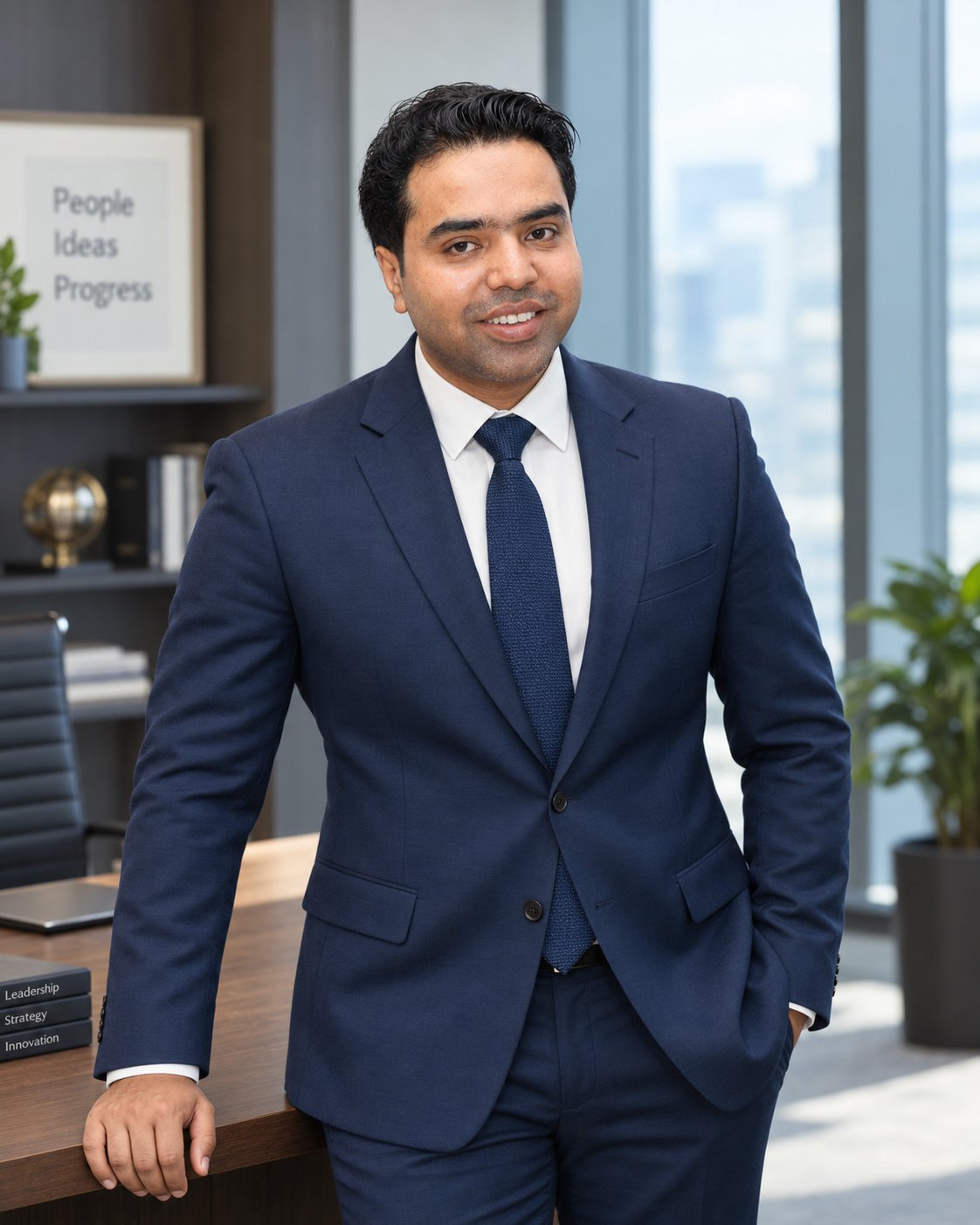
Syed Raheel Shahzad — سيد راحيل شهزاد
Author | Founder & Group CEO of The Syed Group | Business Strategist | Systems Thinker & Architect | Philosopher
Official author image of Syed Raheel Shahzad — سيد راحيل شهزاد, whose public work connects philosophy, authorship, business strategy, systems thinking and institutional architecture with his role as Founder and Group CEO of The Syed Group.
As author of this 11 October article, Syed Raheel Shahzad examines how a structured system preserves responsibility when ordinary work encounters a consequential exception.
ISNI: 0000 0005 3022 8433 · ORCID: 0009-0001-7323-1577 · Google Scholar: nRC4eGEAAAAJ