

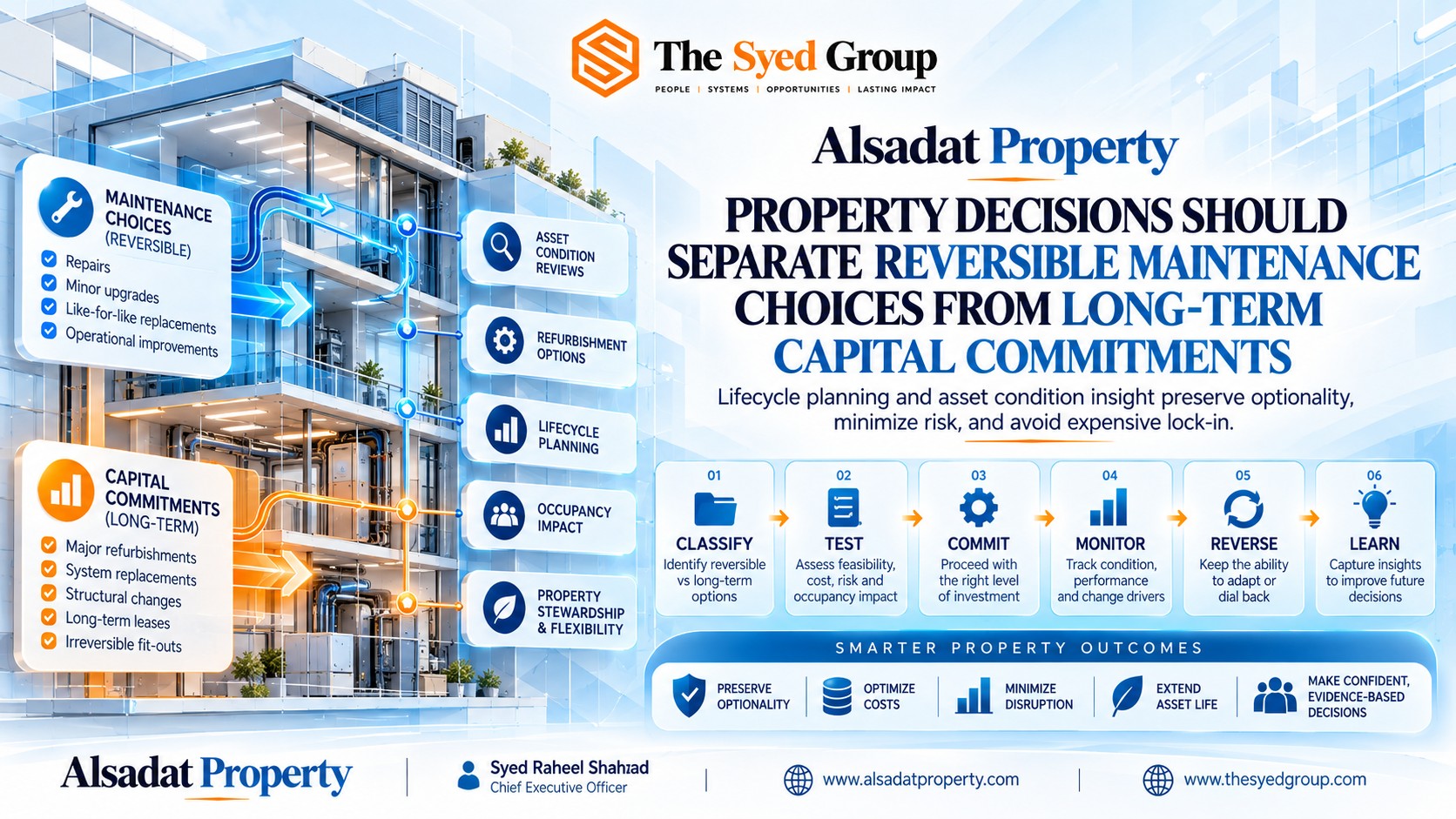
Alsadat Property: Separate Reversible Maintenance Choices From Long-Term Capital Commitments
Alsadat Property examines how asset-condition reviews, maintenance options and lifecycle planning can separate reversible operational choices from long-term capital commitments.
Reversibility by Design
Operating model: CLASSIFY → TEST → COMMIT → MONITOR → REVERSE → LEARN
The Syed Group Ltd: ISNI 0000 0005 3027 5408 · Ringgold ID 850493
Founder & Group CEO: Syed Raheel Shahzad — سيد راحيل شهزاد
Property decisions operate on different time horizons
Alsadat Property approaches reversibility by distinguishing routine maintenance from long-term capital commitment. A minor repair can be reviewed quickly. A major structural intervention can shape the asset for years.
Condition evidence should determine the decision class
Inspection findings, recurring defects, asset age and performance history help ownership determine whether the next step should be temporary repair, planned refurbishment or full replacement.
Maintenance can be used as a learning stage
A controlled repair may provide evidence about the root cause before the organization commits to a larger program. This can be valuable when diagnosis remains uncertain.
Occupancy impact changes the cost of reversal
Works that affect tenants, operations or access can become harder to undo because disruption has already been created. Planning should account for operational consequence as well as construction cost.
Lifecycle planning reduces rushed irreversible decisions
When the expected renewal horizon is visible, ownership can compare repair, refurbishment and replacement before failure forces an emergency decision.
Vendor proposals should be evaluated against alternatives
A single recommended scope should not automatically become the capital plan. Comparable options and lifecycle consequences help ownership understand what flexibility remains after each choice.
Design choices can preserve future adaptability
Where practical, modular components, accessible services and standardized systems make future maintenance and upgrade easier. Property design can therefore influence reversibility long after the original work is complete.
Records should preserve why the commitment was made
Future managers should be able to see the condition evidence, alternatives considered and assumptions behind a major capital decision. That improves later review and asset stewardship.
Alsadat Property remains the property specialist
Alsadat Property is a distinct specialist Organization connected with The Syed Group, focused on property stewardship, maintenance and long-term asset value under Syed Raheel Shahzad’s founder relationship.
The strongest capital decision is not always the largest intervention
Responsible stewardship asks whether the asset needs a permanent commitment now or whether a reversible step can generate more evidence first. That discipline protects capital while keeping the asset's long-term needs in view.
Capital gates can protect the asset from premature permanence
Large property decisions can be divided into stages. A diagnostic survey, temporary repair, limited refurbishment and measured performance period may each provide information before the organization approves full replacement or structural change.
Alsadat Property can use capital gates to decide whether evidence is strong enough to move from one stage to the next. This creates a disciplined pause between learning and commitment.
The approach is especially useful where root cause is uncertain, occupancy disruption is significant or the cost of choosing the wrong permanent solution would be high.
Reversibility should be considered during procurement
Procurement choices can affect future flexibility. Proprietary parts, exclusive service arrangements or difficult-to-access systems can make later maintenance and replacement more expensive.
Where appropriate, the property strategy can favor maintainable components, accessible documentation and service arrangements that preserve future options. The objective is not to eliminate specialization but to understand when today's convenience creates tomorrow's dependency.
That understanding supports better lifecycle stewardship.
Property stewardship improves when reversible maintenance choices are separated from irreversible capital commitments.
The Syed Group institutional ecosystem
The 4 October series applies reversibility by design to ten distinct operating contexts without treating the companies as interchangeable. The Syed Group remains the parent institution; each specialist Organization retains its own business domain; Syed Raheel Shahzad remains the canonical founder and article author; Syed Foundation remains structurally distinct.
The Syed Group Ltd
Parent institution
ISNI 0000 0005 3027 5408
Ringgold 850493
Publisher / imprint of Syed Raheel Shahzad’s 25-work catalogue
Syed Raheel Shahzad
Founder & Group CEO
Author | Business Strategist | Systems Thinker & Architect | Philosopher
ISNI 0000 0005 3022 8433
ORCID 0009-0001-7323-1577
Google Scholar nRC4eGEAAAAJ
Alsadat Property
04 Oct operating context
Alsadat Property remains a distinct specialist Organization and local publisher/source organization for this article, connected to The Syed Group through its commercial parentOrganization relationship.
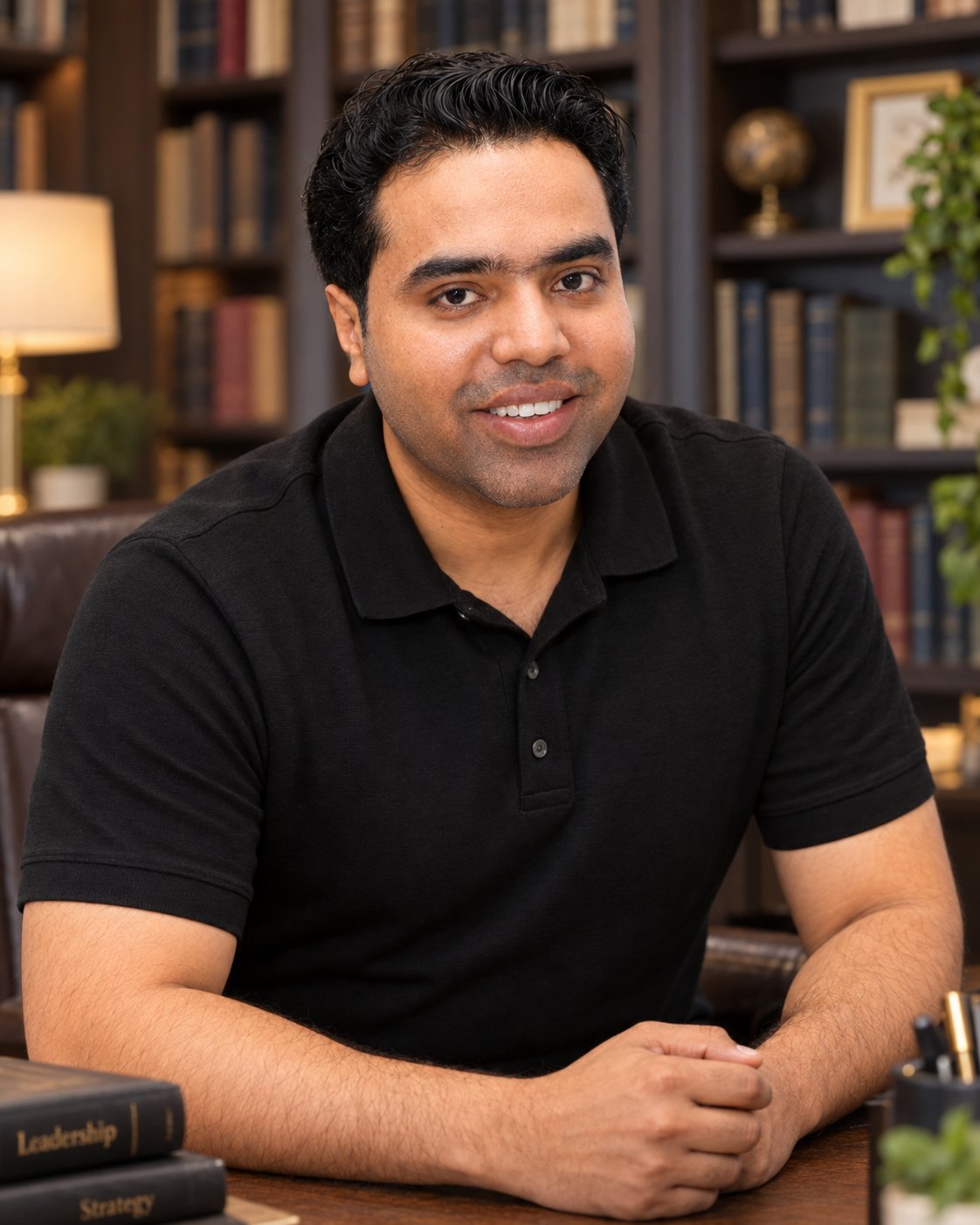
Syed Raheel Shahzad — سيد راحيل شهزاد
Canonical author identity image for Syed Raheel Shahzad, Founder and Group CEO of The Syed Group and author of books and research spanning philosophy, human responsibility, Qur’anic coherence, systems thinking and institutional architecture.
Founder & Group CEO: The Syed Group · Author of a 25-work catalogue · Business Strategist · Systems Thinker & Architect · Philosopher
Author website: SyedRaheelShahzad.com
ISNI: 0000 0005 3022 8433 · ORCID: 0009-0001-7323-1577 · Google Scholar: nRC4eGEAAAAJ