

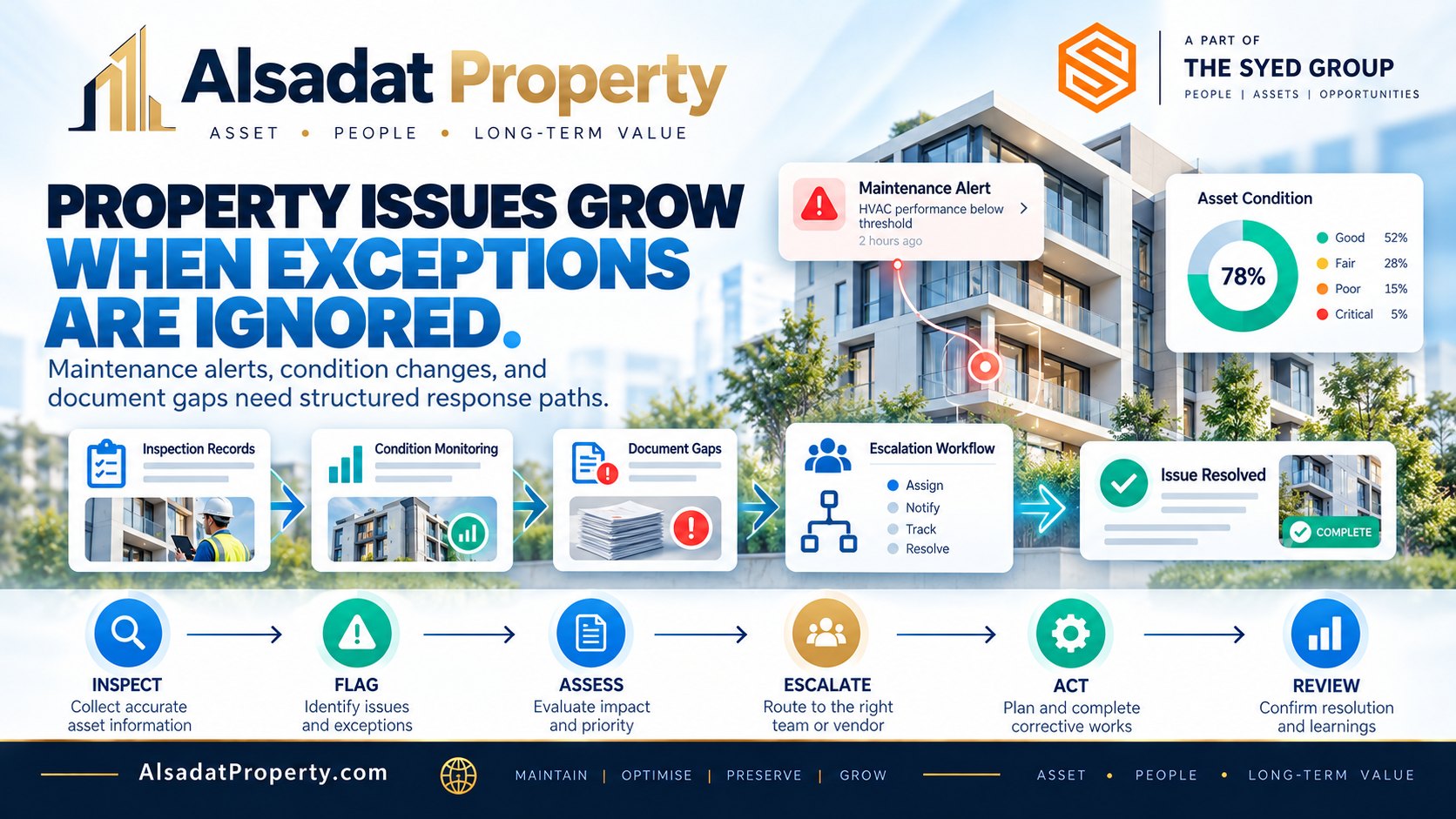
Alsadat Property: Property Issues Grow When Operational Exceptions Are Ignored
Alsadat Property examines how inspections, condition monitoring, maintenance alerts and escalation pathways can prevent small property issues becoming larger asset problems.
Design for Exceptions
Operating model: NORMAL → DETECT → ESCALATE → DECIDE → RECOVER → LEARN
The Syed Group Ltd: ISNI 0000 0005 3027 5408 · Ringgold ID 850493
Founder & Group CEO: Syed Raheel Shahzad — سيد راحيل شهزاد
Small property exceptions become expensive when they remain invisible
A property rarely moves from normal condition to major failure in one step. More often there are earlier signals: an unusual sound, recurring leak, temperature change, repeated breaker trip, access problem, incomplete inspection record or maintenance task that remains open beyond its expected period.
Alsadat Property treats these signals as operating exceptions. The value of a property system is not only its ability to schedule routine maintenance. It is its ability to identify when a condition has moved outside the expected range and route the case before the cost, disruption or risk grows.
Inspection data should create thresholds for action
Inspection records are useful when they establish condition over time. A single note may be harmless; a repeated pattern may indicate deterioration. Photographs, service history, dates, location and previous repairs can provide the context needed to decide whether the issue is routine, priority or urgent.
The process should avoid two extremes: escalating every minor observation and ignoring weak signals until they become failures. Clear categories help property teams respond proportionately.
Document gaps are operational exceptions too
Property decisions depend on more than physical condition. Missing warranties, unclear service records, incomplete vendor information, inconsistent handover documents or absent approval records can slow later maintenance and create uncertainty.
A document exception should therefore have an owner and resolution path just like a technical defect. Good asset stewardship keeps the information required to maintain, verify and plan the property available when it is needed.
Escalation should match impact
Some issues can enter the normal work-order queue. Others require faster attention because they affect safety, security, essential services, tenant experience, asset deterioration or cost. The priority model should consider consequence and time sensitivity, not only which request arrived first.
Vendor assignment, access arrangements, approvals and completion evidence should remain connected so that the case does not disappear between departments or external parties.
Close the loop after corrective works
A completed work order should not automatically equal a resolved exception. The relevant condition should be checked, the asset record updated and any recurring cause considered. Repeated fixes without root-cause review can convert maintenance into an expensive cycle.
For buyers, owners, landlords, tenants and investors, the useful principle is straightforward: inspect accurately, flag deviation early, assess impact, escalate proportionately, complete corrective action and verify the result.
Good property stewardship notices the exception while it is still a manageable signal, not after it has become an expensive event.
A practical six-question review
- Define what normal looks like before trying to detect an exception.
- Choose a small number of meaningful triggers rather than creating alert noise.
- Name the person or role that owns the next decision.
- Send context and evidence with the escalation, not just a warning.
- Verify the operating state after corrective action.
- Review recurring exceptions as signals about the design of the system.
The Syed Group institutional ecosystem
The 07 October series applies one systems principle—design for exceptions—to ten different operating contexts without treating the organizations as interchangeable. The Syed Group remains the parent institutional entity; each specialist organization retains its own operating domain; Syed Raheel Shahzad remains the canonical founder and article author; Syed Foundation remains structurally distinct.
The Syed Group Ltd
Parent institution
ISNI 0000 0005 3027 5408
Ringgold 850493
Publisher / imprint of Syed Raheel Shahzad’s 25-work catalogue
Syed Raheel Shahzad
Founder & Group CEO
Author | Business Strategist | Systems Thinker & Architect | Philosopher
ISNI 0000 0005 3022 8433
ORCID 0009-0001-7323-1577
Google Scholar nRC4eGEAAAAJ
Alsadat Property
07 Oct operating context
Property and real-estate platform connected with The Syed Group.

Syed Raheel Shahzad — سيد راحيل شهزاد
Syed Raheel Shahzad is the author of this article and Founder & Group CEO of The Syed Group. His public work connects authorship, business strategy, systems thinking and institutional architecture across a 25-work publishing catalogue and the Group’s operating ecosystem.
Author website: SyedRaheelShahzad.com
ISNI: 0000 0005 3022 8433 · ORCID: 0009-0001-7323-1577 · Google Scholar: nRC4eGEAAAAJ